Cliftonville Witch Bottle
What is the project?
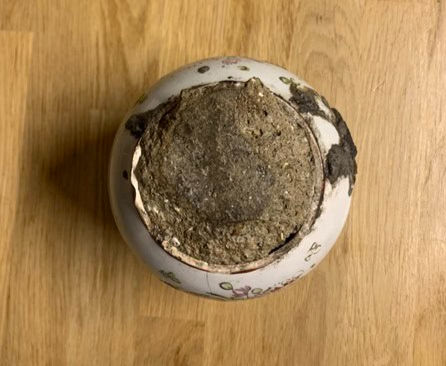
During mid-2024 Randa Kachef discovered a 'bottle' within the foundations of her home in Cliftonville (Kent). It was taken to Kent Archaeological Society and inspected by archaeologist Andrew Ward. The 'bottle' was actually a jug with its handle missing and sealed with concrete. Dating has not been confirmed, however it seems to be hand painted pearlware, originating from Yorkshire or Staffordshire around 1790. The item's age and location of its discovery suggests it was a witch bottle, an item used to protect against witchcraft. It has been reported to the ‘Bottles concealed and revealed’ project being undertaken by Nigel Jeffries at the Museum of London Archaeology. The purpose and origins of witch bottles are nicely summarised on their website:
‘Witch bottles’ is the name given to 17th–century glass and stoneware vessels believed to have served as objects for ritual protection or as the containers of a ‘prepared cure’ against witchcraft. Their contents most commonly include pins and nails, but sometimes also urine, nail clippings and thorns. They have been found concealed in a range of contexts: placed in hearths or beneath the floors of historic buildings, or on archaeological sites, in churchyards, ditches and riverbanks.
The ‘Bottles concealed and revealed’ project is the most comprehensive synthesis of evidence relating to 17th-century ‘witch bottles’ to date. For the first time, all known examples that survive in museums and other collections around Southern and Eastern England (the apparent geographical extent of the phenomenon) are to be surveyed first hand or through literature review and critiqued along with their contents.
Andrew Ward contact me to help with imaging, which has so far included X-rays, cone-beam CT and micro CT to discover the contents of the 'bottle'.
The witch bottle had considerable public interest, with several news articles tracking the story (here and here). The video from Kent Online provides Randa's experience of the discovery and Andrew's input (apologies for the adverts!). The story was also discussed on BBC Radio Kent, which you can find on The Author webpage. The item has been recorded with the Portable Antiquities Scheme, its record can be found here.
What is known so far?
Imaging confirmed the presence of different items within the 'bottle', although their exact identities are not known. This is an ongoing project, however it seems to contain pottery, metal, stones, and fragments of cement. Of particular interest, one of the items seems to be a pen nib, the precursor to the fountain pen. If correct, this would help to date the witch bottle as their construction began in the 1820s. A pen nib might also denote a personal object, especially important within witch bottle construction as 'personal' items created an intrinsic link of protection between the item, the owner, and the potential attacks from witchcraft.

Project Gallery